The 8 Best Party Board Games for Large Groups (2025): Guaranteed Fun
Discover the best party games to liven up any gathering in 2025. Complete guide to party games: Jungle Speed, Time's Up, Virus, Mente Vacuna and more. Perfect for large groups, simple rules and guaranteed laughs.
The 8 Best Party Board Games for Large Groups (2025): Guaranteed Fun
There's something magical about those gatherings where people forget about their phones, conversations fill with laughter, and everyone is totally hooked on what's happening at the table. I'm not talking about formal dinners or quiet evenings with wine, but about those parties and gatherings where what you want is energy, unbridled fun, and creating moments that will be remembered for years.
Traditional board games (the lifelong Trivial Pursuit, the endless Monopoly, the usual Spanish cards) have their moment, but when what you're looking for is to liven up a party, break the ice with new people, or simply have a blast with friends, you need a different type of game. Games that are explained in two minutes, where everyone can participate at once, where it doesn't matter if someone has had three drinks too many, and where laughter is guaranteed from the first second.
In this article I bring you a selection of 8 games that transform any gathering into a memorable party. They're not deep strategy games or thinking three moves ahead. They're pure fun, adrenaline, reflexes, creativity and above all, moments that keep people laughing. Games that have proven to work again and again at birthdays, farewells, dinners with friends, family reunions or any occasion where you have a group of people wanting to have a good time.
What Makes a Game Perfect for Parties?
Before getting into the list, it's worth understanding what characteristics make a game work in the context of a party or large group. Because not all games work for this, and in fact, many fantastic games in other contexts are an absolute disaster when you have 8 people at a table with beers in hand.
Ultra-simple rules explained in minutes. At a party no one wants to hear a 15-minute manual. You need games that you can literally explain in 2-3 minutes and that people understand from the first round. Even better if you can do a test round that doesn't count and everyone's already got it.
Everyone plays at once or turns are super fast. Nothing kills a party's energy more than waiting 10 minutes for your turn while six people make their moves. The best party games have turns of 5-10 seconds, or directly everyone plays simultaneously. People want to be active, not spectating.
Allow entering and leaving without breaking the game. At a real party, people come and go: someone goes out to smoke, another to the bathroom, new people arrive who want to join... Party games work better when you can add players between rounds or when someone can leave without stopping everything.
Generate funny moments naturally. You don't need to be particularly witty or creative for these games to work. Comic situations emerge on their own: someone makes a mistake, another does something ridiculous under pressure, synchronizations fail... Laughter is integrated into the mechanics.
Winning doesn't matter so much. In party games, scoring is usually secondary. Of course there's a winner at the end, but no one goes home frustrated because they lost. What matters are the moments: that epic scream playing Jungle Speed, that impossible mime in Time's Up, that perfect card in Virus that saved you at the last moment...
How We Selected These Games
For this list I applied very specific criteria based on years testing games in real party contexts:
Battle-tested. All these games I've seen working at real parties, with people who aren't regular players, with groups of 6-12 people, and with different levels of sobriety. They're not theories, they're games that really liven up any gathering.
Accessible to everyone. No one is left out. You don't need to be particularly fast, very creative, or have previous knowledge. From your 60-year-old aunt to your 12-year-old cousin, everyone can play and enjoy.
Work with large groups. All these games handle well from 4-5 players up to 8-12 (some even more). Because at a party you never know exactly how many people will want to play.
Reasonable price. Party games shouldn't cost €60. Most of these titles are between €15-30, which makes them perfect to have several at home and take to any gathering.
Available in Spain. All these games can be easily obtained in Spanish stores, many are in Spanish, and some are even from Spanish publishers.
Now yes, let's go with the 8 games that best meet these criteria and guarantee fun at any party.
The 8 Best Party and Large Group Games
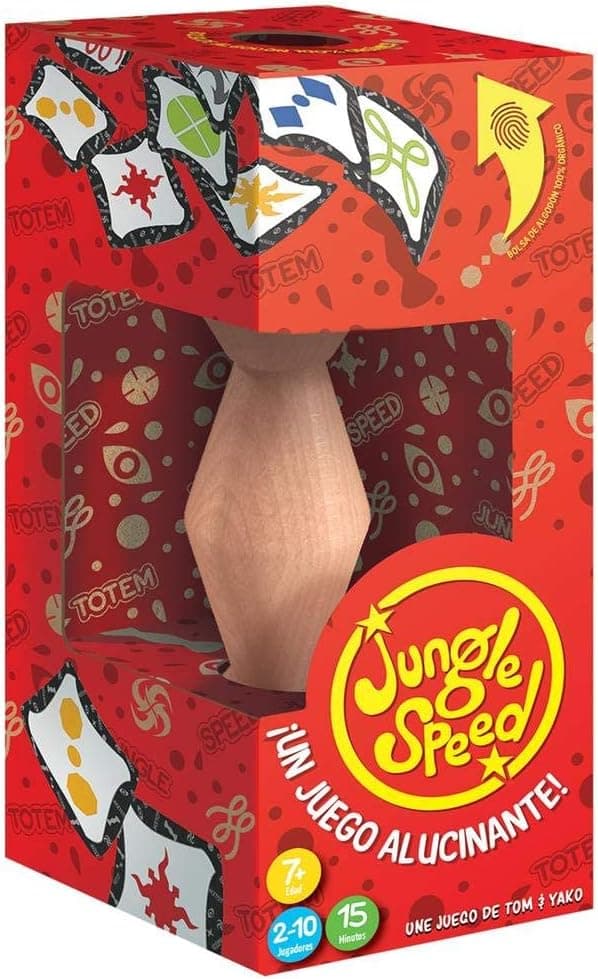
1. Jungle Speed
What is it? Jungle Speed is pure adrenaline in card game form. Each player has a deck of cards with symbols of different shapes and colors. On your turn, you flip a card. If your symbol matches another player's, you both must grab the wooden totem in the center of the table! The fastest gets rid of their cards, the slow one keeps them all. The goal is to run out of cards.
Why is it the king of party games? Because it combines elements that work perfectly: reflexes, growing tension and moments of absolute chaos. The magic of Jungle Speed is in that fraction of a second when you flip your card and everyone quickly scans if it matches any other. Your brain is hyper-alert, your hand ready hovering over the table, and when you see the match... instinct takes over. There are screams, epic lunges over the table, people throwing the totem to the floor, hands colliding in the air...
The great thing is that it doesn't matter if you're a strategist or not, if you're good at board games or an absolute novice. Jungle Speed is the great equalizer: the only thing that counts is your reaction speed and your controlled aggressiveness to grab that totem. I've seen games where the shyest person at the gathering transforms into a competitive machine, jumping over the table to get the totem before anyone else.
Also, it has special cards that add chaos: cards that make EVERYONE try to grab the totem at once, cards that temporarily change the rules (now colors match instead of shapes), cards that force you to do specific actions... These elements keep the game unpredictable and fresh round after round.
Games are quick and fluid: 10-15 minutes normally. Perfect for party rhythm. When a game ends, immediately someone says "another one!" because the loser wants revenge and the winner wants to reaffirm their supremacy. And since it's so fast, there's always time for several rounds.
An important tip: play on a sturdy table and remove glasses from the middle. Seriously. Jungle Speed can end with spilled glasses and liquids if you don't take precautions. The excitement of the moment makes people lunge without care, and more than once I've seen beers flying through the air.
For whom: Groups of 4-10 people (works even with more if you squeeze in). Especially indicated for that moment of the party where energy is high and people are in friendly competitive mode. Less recommended if there are people with hand mobility problems or very slow reflexes (although they can participate with handicap, like "count to 3 before grabbing").
Duration: 10-15 minutes | Players: 2-10 (ideal 4-8)
2. Time's Up!
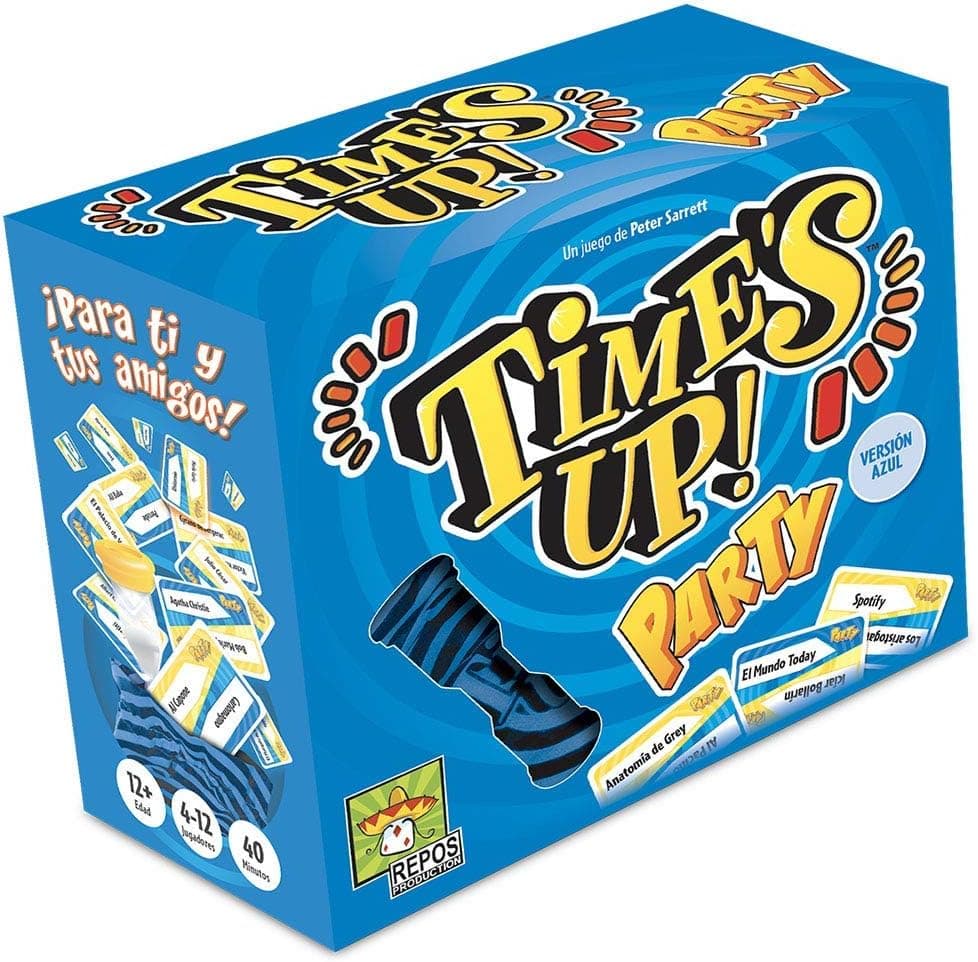
What is it? Time's Up is probably the best team guessing game that exists. It's played in three rounds with the same 40 character cards. In the first round you can say whatever you want (except the name on the card), in the second you can only say ONE word, and in the third you must mime without talking. Teams compete to guess the maximum cards in 30 seconds.
Why does it work so well at parties? Because of the difficulty progression that creates increasingly hilarious situations. The first round is relatively calm: "Okay, he was president of the United States, assassinated in Dallas, his initials are JFK..." Easy, right? But when you get to the third round and you have to mime that same character without saying anything, with your partner shouting random names while time runs out... that's when chaos and laughter explode.
The brilliant thing about the design is that you use the same cards in all three rounds. This means that in the second and third rounds you've already seen those characters, so you have to remember which they were and your partner must connect your ridiculous clue with the memory from the first round. "KISSES!" shouts your partner in the second round. "Really? 'Kisses' is your only word for Madonna?" "Well you told me in the first round she was the queen of pop and gave lots of kisses on stage!" It's that type of interaction remembering previous clues that makes Time's Up especially memorable.
The game works fantastically in teams, which is perfect for parties where you want people to interact and mix. You can make teams of 2, 3 or even 4 people per team if you're many. And being in teams, no one feels bad if they fail: it's shared responsibility and shared victory.
The cards include all kinds of characters: historical (Cleopatra, Napoleon), musicians (Freddie Mercury, Beyoncé), actors, politicians, fictional characters (Harry Potter, Sherlock Holmes), athletes... The variety ensures there are always cards that some know and others don't, which naturally balances the game.
A trick that works great: if in your group there are very varied ages or people from different generations, Time's Up levels the playing field because cultural references compensate. Older people know better old politicians and classic singers, young people dominate modern pop references, and in mime everyone is equally lost.
For whom: Groups from 4 to 12-14 people (playing in large teams). Especially good for groups where people don't know each other much, because the game breaks the ice naturally. Works wonderfully at birthdays, farewells, Christmas dinners...
Duration: 30-45 minutes | Players: 4-12+ (in teams of 2-3)
3. Virus!
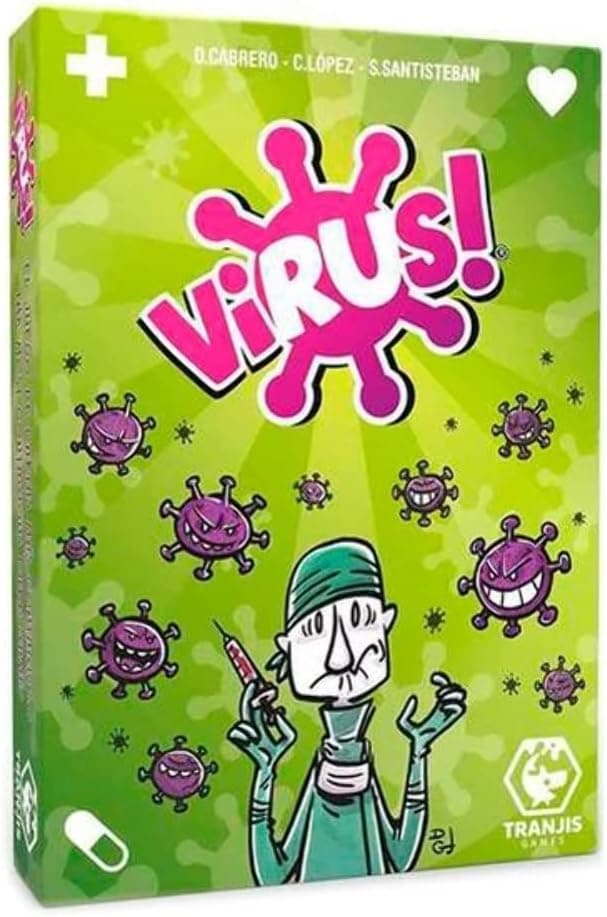
What is it? Virus is a Spanish card game where each player tries to build a healthy body of four organs while attacking others with viruses, stealing organs with transplants or defending with medicines and vaccines. The first to have four healthy (or immunized) organs wins.
Why is it a resounding success? Because it's Spanish, cheap, fast and brutal. Trident Games hit the nail on the head with this design: rules explained in 3 minutes, 20-minute games, constant direct interaction and a price of about €12-15 that makes it an almost mandatory purchase for any personal game library.
The game has an inherent wickedness that's very fun. You're calmly building your healthy body when suddenly your friend hits you with a virus on the heart. "I'm going to cure you!" says your girlfriend while putting medicine on you. But then your brother arrives with a transplant and steals that cured heart to put it in his own body. Betrayal is constant, temporary alliances ("don't attack me this turn and I won't attack you") break immediately, and each card can completely change the state of the game.
The mechanics are simple but have tactical depth. Do I play this virus now or wait until he has more organs to mess him up later? Do I spend my medicine curing myself or helping my friend who's also helping me? Do I vaccinate this organ so no one can touch it or save the vaccine for something better? These simple but interesting decisions keep everyone hooked turn by turn.
Visually, the cards are funny and well designed: caricatured organs with faces, viruses looking like bad bugs, medicines in pill form... All very iconographic and clear. In 30 seconds you already identify what each type of card does.
And the best: the game sells out quickly in stores, which has created a kind of cult around it. If you see it available, buy it without thinking twice. Plus there are already expansions (Virus 2 Evolution) that add more variety if after 50 games you start to feel it repeats.
For whom: Groups of 2-6 players, although with 4-5 is when it shines most. Perfect for young people (teenagers and adults up to thirties love it), although really anyone can enjoy it. It's the game that's always in my backpack when I know I'm going to a gathering where there will be games.
Duration: 20-30 minutes | Players: 2-6 (ideal 4-5)
4. The Mind
What is it? The Mind is a minimalist cooperative game where all players must place numbered cards from 1 to 100 in ascending order, but without talking or communicating in any way. You simply must "connect mentally" and feel when it's the moment to play each card.
Why is it special? Because it's pure cooperative in an ultra-simple format. There's no board, no formal turns, no leader dictating what to do. There's only silence, tension and that telepathic connection that emerges when a group of people try to synchronize without words.
The experience of playing is almost meditative at first: everyone looking at their cards, no one says anything, silence becomes thick... Then someone feels it's the moment and puts down a 7. Does anyone have an 8, 9, 10? More silence. Another player puts down a 15. Oops! Someone had a 12 but didn't play it in time. You lose a life. But little by little, round after round, the group starts to understand each other. You start reading body language (without making it explicit), feeling each person's timing, developing that shared intuition.
The magic is when it works: that feeling of putting your card at the perfect moment, without talking, and it fits with what others were thinking. It's almost mystical. I've seen groups that after a few games develop impressive synchrony and start completing levels that seemed impossible.
It's a game that generates another type of laughter: not the explosive guffaws of Jungle Speed, but those nervous giggles when someone puts a card too early, those frustrated "nooo..." when the chain breaks, those silent celebrations (gestures, fists in the air) when you complete a difficult level.
It works especially well as a change of pace in a party night. After several noisy and chaotic games, The Mind offers a calmer but equally intense respite. And since it's cooperative, there are no losers who feel bad; either you all win or you all lose together.
For whom: Groups of 2-4 players (the base game), although there's The Mind XXL that allows up to 8. Surprisingly, it works even with people who've had a few drinks, because the required concentration creates comical situations. "Stop looking at me like that, I can't think!" "I'm not looking at you, I'm looking at my cards!" "Well your face is in my direction!"
Duration: 15-20 minutes | Players: 2-4 (base) or 2-8 (XXL)
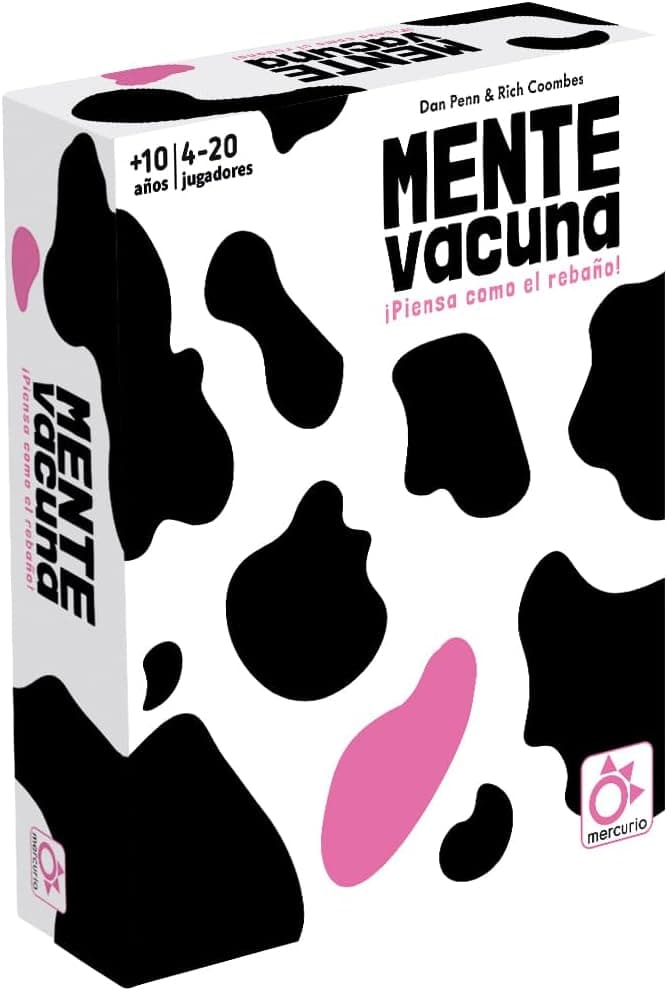
5. Monster Match
What is it? Monster Match is a set collection game designed by Reiner Knizia. Players roll dice and according to results must take monster cards of colors. Your goal is to collect sets of monsters of the same color, but careful: if you go too far rolling and can't take any valid card, you lose everything you accumulated that round.
Why is it engaging? Because of the press-your-luck element that generates delicious tension. Each time you roll the dice, you must decide: do I stick with what I have or risk another roll? I already have three yellow monster cards... do I roll again to get a fourth? But if I roll colors I can't use anymore... I lose everything!
That decision moment is pure contained adrenaline. All other players are watching you, some encouraging you ("roll, roll!"), others laughing anticipating your disaster ("you're going to fail, I know it"), and you weighing probabilities in your head. When you roll and exactly what you needed comes out, the satisfaction is immense. And when you fail and lose everything, the laughter and "I told you so" fill the table.
The game has very simple rules but interesting decisions. Do I go for many cards of one color or diversify? Do I risk rolling again even though the odds are against me? Do I stick with few but safe cards? These micro-decisions make each round exciting.
The "fluffy" monster illustrations are adorable, which gives a funny contrast with the game's tension. They're like colored stuffed animals with funny faces. This makes it very visually accessible and even younger children feel attracted to the game's appearance.
For whom: Groups of 2-5 players, although it works better with 3-4. It's perfect for that audience that doesn't want very complex games but yes something with more substance than just rolling dice. Families, casual friend groups, even as a filler (quick game between longer ones) at gatherings of more experienced players.
Duration: 15-25 minutes | Players: 2-5 (ideal 3-4)
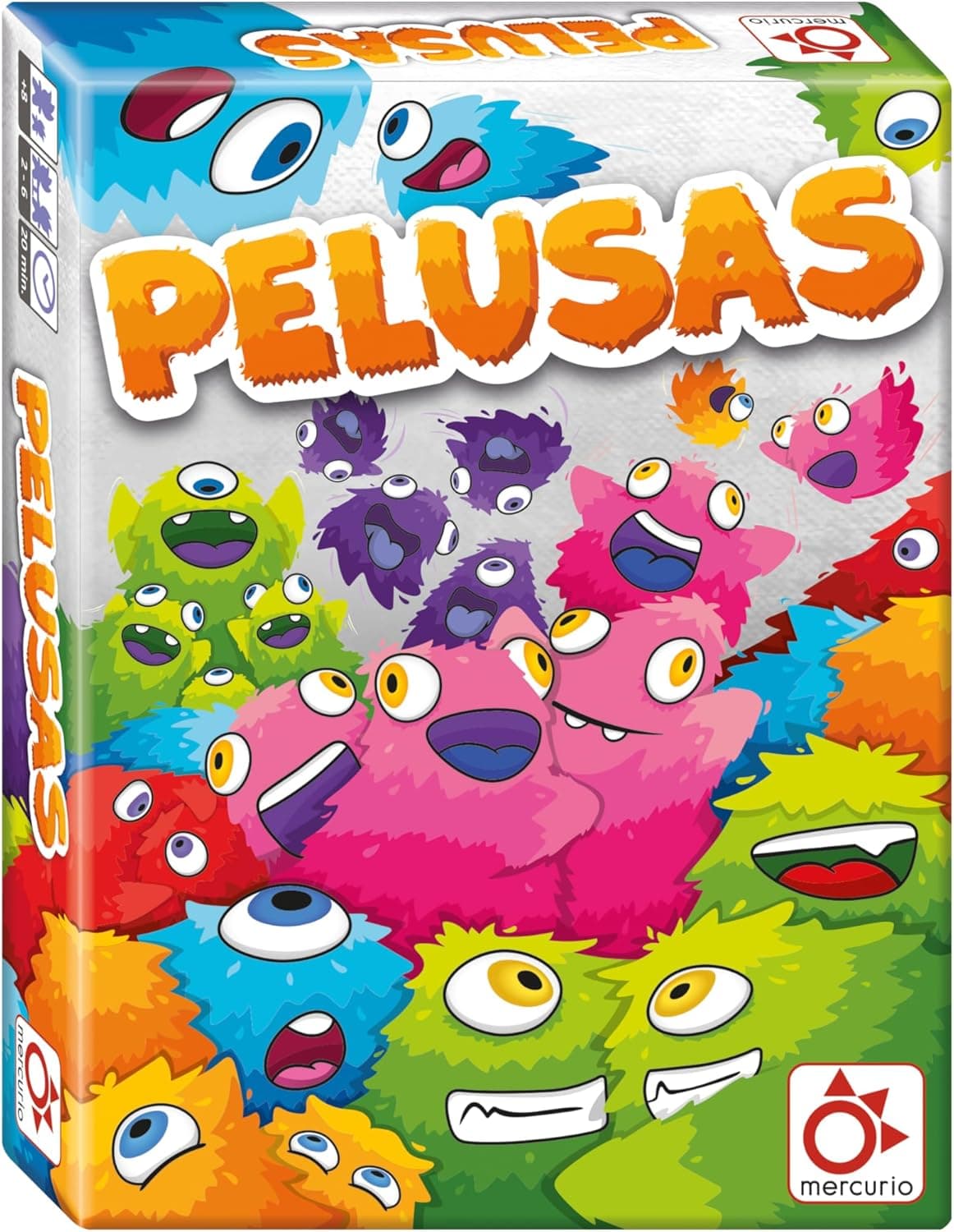
6. Warehouse 51
What is it? Warehouse 51 is a physical Tetris-type game where each player has a warehouse (personal board) and must place tiles of different shapes trying to complete contracts that ask for specific combinations of boxes. You have to make room, stack well and be more efficient than others.
Why does it work at parties? Because it combines spatial puzzle with direct competition and time pressure. It's not just a calm Tetris where you think your move for minutes; here there's interaction, drafting (you choose tiles others also want), contracts that multiple players compete to complete, and there's physical satisfaction in fitting pieces into your warehouse.
The mechanic of placing tiles has something hypnotic and satisfying. Seeing how your warehouse fills up orderly (or chaotically, depending on your strategy) while trying to maximize space is very visual and tactile. And when you manage to complete a difficult contract by fitting that piece perfectly in the exact gap... chef's kiss.
There are interesting tactical decisions: do I take this tile I need or take that other one to mess up the rival who wants it? Do I focus on small quick contracts or go for the big high-points contract? Do I strategically leave empty spaces for future pieces or try to fill everything? It's not a super deep game, but it has more strategic meat than other party games.
The game is visually clear and attractive: each tile has drawn colored boxes, contracts clearly show what combination you need, and seeing all players' warehouses full of colorful tetrominos is very satisfying.
For whom: Groups of 2-4 players. Works especially well with groups that enjoy games with a little more weight than typical party games but without reaching complex strategies. Also great for groups where there are players of different levels: novices can play simply while experienced ones optimize.
Duration: 30-40 minutes | Players: 2-4
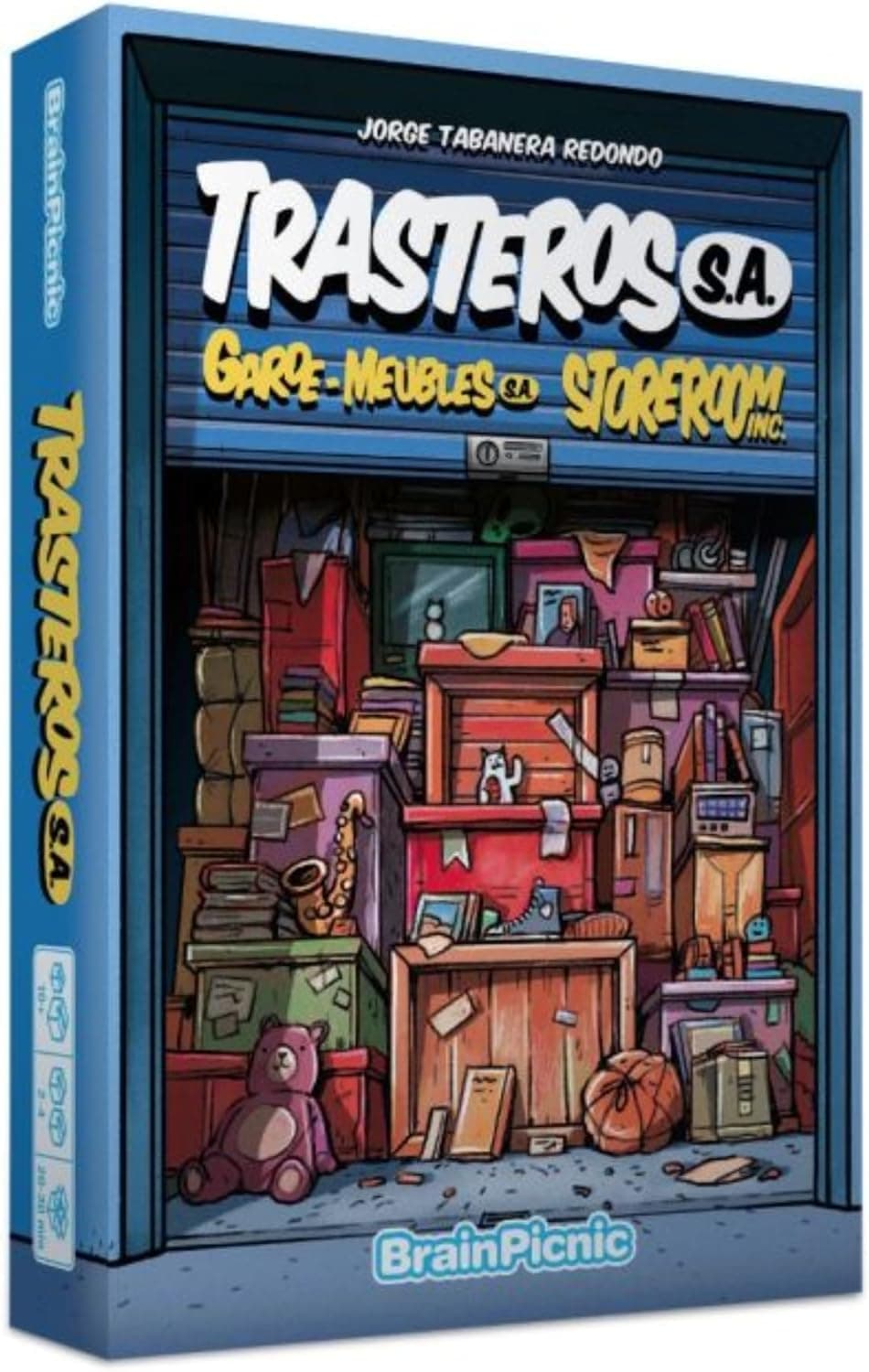
7. Taco Cat Goat Cheese Pizza
What is it? Possibly the game with the most absurd and memorable name on this list. It's ultra-simple: there's a deck of cards, each player puts a card in the center saying in order "Taco", "Cat", "Goat", "Cheese", "Pizza" (and the cycle repeats). When the card placed matches the word said, everyone must put their hand on top of the pile! The slowest takes all the cards. The one who runs out of cards wins.
Why is it so fun being so simple? Because the brain isn't designed for this. It seems super easy: you just have to pay attention if the card matches the word. But your brain constantly gets confused. You're saying "Cheese" while looking at a cheese card and your mind screams "IT MATCHES!!" but it's already too late and three other players already have their hand on the pile laughing at you.
Also, there are special cards that add absurd actions: when the "Gorilla" card comes out everyone must beat their chest, when "Groundhog" comes out everyone must hit the table, when "Narwhal" comes out everyone must make a horn gesture on their head... These random interruptions add marvelous chaos. You're super concentrated on the "Taco-Cat-Goat" when suddenly someone puts a Gorilla and everyone starts beating their chest like crazy.
It's a game of reflexes but also mental stamina. After 10 minutes your brain is exhausted from processing information so fast, your reflexes start to fail, and mistakes multiply generating more laughter. "I said 'Pizza' seeing a Taco and still put my hand down! My brain is broken!"
The format is perfect for parties: fits in a pocket, explained in 30 seconds, you can play up to 8 people squeezed together, games are 10-15 minutes and nobody takes it seriously. It's pure fun chaos.
For whom: Literally anyone from 8 years to 99. Works especially well with groups where there are people who don't speak the same language (can be played in any language, you just need everyone to say the same five words in order), or in groups with a few drinks on top (in fact, it might even be more fun).
Duration: 10-15 minutes | Players: 2-8 (ideal 4-6)
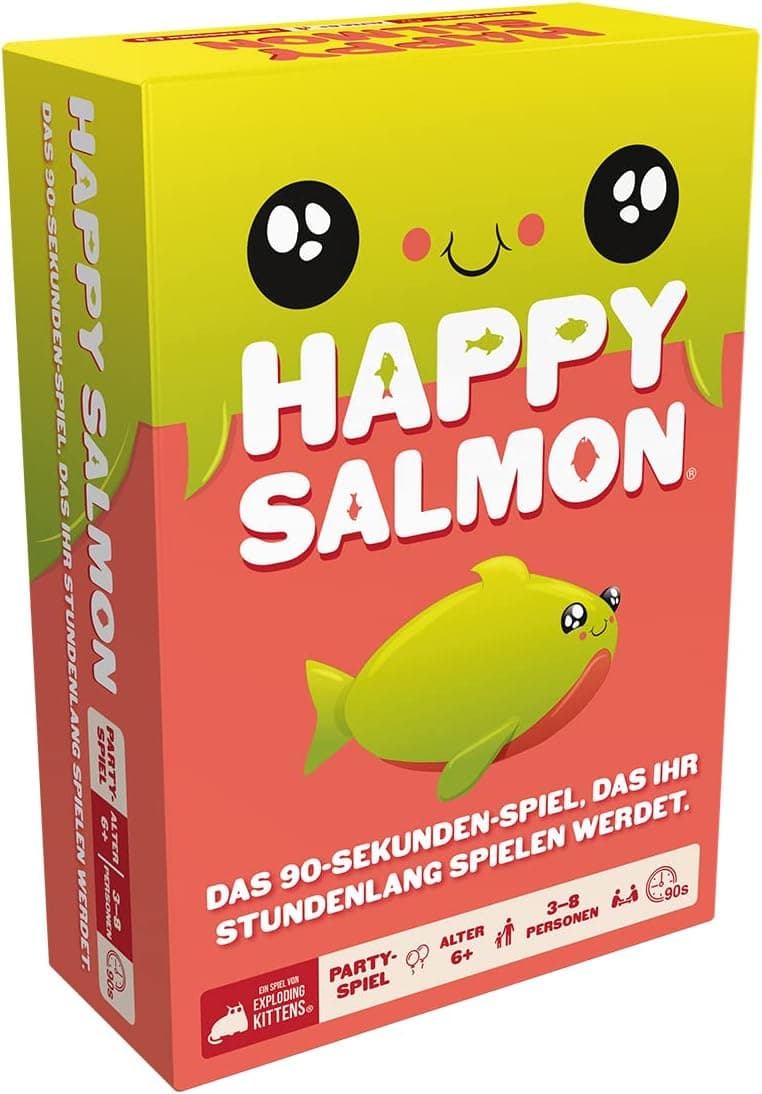
8. Happy Salmon
What is it? Happy Salmon is madness in its pure state. Each player has 12 cards with four different actions: "High Five" (high five), "Pound It" (fist bump), "Switcheroo" (switch positions) and "Happy Salmon" (do the salmon gesture: flap arms up and down while making noise). Everyone plays simultaneously shouting their actions looking for someone who has the same one to execute it together and discard. The first to run out of cards wins.
Why is it the purest and most fun chaos? Because there are no turns, everyone plays at once. Imagine 6-8 people in a circle, all shouting at the same time "HIGH FIVE!", "SWITCHEROO!", "POUND IT!", "SALMON!", while moving trying to find someone with their same card. It's noisy, it's frenetic, it's physical (you're moving, high-fiving, switching positions) and it's absolutely impossible not to laugh.
The duration is perfect: 1-2 minutes per round. Yes, you read right. A complete game of Happy Salmon lasts TWO MINUTES. It's the sprint of board games. This speed makes it perfect to play several rounds in a row (we usually play "best of 5" or directly until people get tired), or as a quick game to liven up before starting something else.
The physical component is what makes it unique. You're not sitting quietly in your chair; you're standing, moving, searching, high-fiving, hugging strangers (Happy Salmon is really best done with a quick hug or arm bump), switching positions... It's light physical activity that works great to break the ice or burn energy.
The game comes in a salmon-shaped pouch that's adorable and makes it super portable. You can take it anywhere, even fits in a small purse. And visually, cards have bright colors and action icons are super clear, so even people who don't speak Spanish can play without problems.
An important detail: you need space. Happy Salmon can't be played at a small table with chairs. You need people to be able to stand up, move a bit, have arm space... But if you have that space, it's pure gold.
For whom: Groups of 3-6 players (XL version exists for 6-12). It's especially good for farewells, birthdays, pre-parties, corporate team buildings (many companies use it for group dynamics), or any situation where you want people to move and laugh. Less recommended if there are people with reduced mobility or in very small spaces.
Duration: 2 minutes per round | Players: 3-6 (base) or 6-12 (XL)
How to Choose the Perfect Game for Your Party
Now that you know the 8 games, the question is: which to take to your next gathering? Here are some practical tips.
According to Party Type
Birthday or family celebration: Time's Up is your best bet. Works with all ages, generates laughter without being too wild, and the team format helps people mix.
Bachelor/bachelorette party or intimate friends gathering: Virus or Jungle Speed. They're more chaotic, more competitive, more direct in interaction (attacks, thefts, betrayals). Perfect when the group already knows each other well and can handle heavy jokes.
Dinner with new people or icebreaker: Happy Salmon or Taco Cat Goat Cheese Pizza. They're so absurd and simple they break any social barrier. It's impossible to stay serious and distant when you're shouting "POUND IT!" and fist-bumping with strangers.
Quiet gathering that needs a push: The Mind. It's cooperative, not noisy, but yes intense. Perfect to add a special moment to a dinner without it being too crazy.
According to Number of Players
4-6 people: Any from the list works perfectly. It's the ideal number for most of these games.
7-10 people: Time's Up (in teams), Happy Salmon XL, Jungle Speed or Taco Cat Goat Cheese Pizza. These scale well to large groups.
More than 10: Time's Up is still king. You can make teams of 3-4 people and it works wonderfully even with 16 players divided into 4 teams.
Only 2-4: Virus, Monster Match, Warehouse 51 or The Mind work better in small groups where you want something with more tactical substance.
According to Time of Night
At the beginning (people arriving, medium energy): Virus, Monster Match or Warehouse 51. They're calm enough for when people are still settling in but already add fun.
At peak energy (everyone active, lively atmosphere): Jungle Speed, Happy Salmon or Taco Cat Goat Cheese Pizza. Pure adrenaline that takes advantage when the group is at its best.
After other games (moderate energy): Time's Up or The Mind. The first because it's more cerebral (guessing) than physical, the second because it offers a calmer change of pace.
End of night (people tired but still wanting more): Taco Cat Goat Cheese Pizza or Virus. Short, simple, don't require great concentration, perfect for that moment when you're tired but don't want the night to end.
According to Available Space
Small table / limited space: Virus, The Mind, Monster Match, Taco Cat. All take up little physical space.
Large table or sofa: Warehouse 51, Time's Up, Jungle Speed. Need a bit more surface or space to spread components.
Need space to move: Happy Salmon. This is non-negotiable, you need people to be able to stand and move.
Frequently Asked Questions
Can I take these games to a bar or restaurant?
Depends on the game and venue. Virus, The Mind, Taco Cat and Monster Match are compact and relatively quiet, perfect to take to a table bar. Jungle Speed also works but you need a stable table (nothing wobbly) and for the venue to tolerate a bit of noise and movement. Happy Salmon or Time's Up are complicated in bars because they require either space or teams talking loud.
Are these games expensive?
Not at all. Most are between €12-30:
- Virus: €12-15 (cheapest and one of the best)
- Taco Cat: €10-15
- The Mind: €10-12
- Monster Match: €15-20
- Happy Salmon: €15-20
- Jungle Speed: €20-25
- Time's Up: €25-30
- Warehouse 51: €25-30
They're very reasonable investments considering the hours of fun they give.
Do I need to be an experienced player to enjoy them?
Absolutely not. In fact, these games are specifically designed for people who don't normally play board games. If you've played Uno or Parcheesi at some point in your life, you have enough experience for these games.
Where can I buy them?
- Specialized board game stores: Zacatrus, Más Que Oca, Jugamos Todos, or your local neighborhood store
- Amazon: Usually have them all with fast shipping
- Large retailers: Some like Virus, Time's Up or Jungle Speed are already at FNAC, El Corte Inglés, etc.
- Second hand: Wallapop or similar, although for €10-15 games maybe not worth it
Do they work well if some players have drunk alcohol?
Curiously, many of these games work BETTER with a couple drinks on top (responsibly, obviously). Alcohol reduces social inhibitions, which makes people laugh more easily, dare more to make a fool of themselves in Time's Up, be more aggressive in Jungle Speed... That said, if someone is very far gone, better they be a spectator because some games require coordination (Happy Salmon) or attention (The Mind).
If I can only buy ONE, which do I choose?
For maximum versatility: Time's Up. Works from 4 to 12+ players, with all ages, at any type of gathering, and practically never fails. It's the safest.
If you want something cheaper and portable: Virus. For €12 you have one of the best party games available, fits in a pocket and works in almost any context.
If you want pure madness and energy: Jungle Speed or Happy Salmon. They're the kings of adrenaline and guarantee immediate laughter.
Conclusion
Party and large group games have that special power to transform a normal gathering into a memorable night. It doesn't matter if it's a birthday, a dinner with friends, a farewell or simply any Saturday where you've decided to get together: these 8 games guarantee there will be laughter, absurd moments and those anecdotes that are told for years ("remember when María tried to mime Madonna and looked like a chicken?").
The best thing about these games is that they democratize fun. You don't need to be particularly intelligent, creative, fast or strategic. You only need the desire to have a good time and be willing to make a bit of a fool of yourself. And when everyone is in the same situation (everyone making fools of themselves, everyone shouting, everyone competing), magic emerges on its own.
My advice: don't stick with just one. Have at least 3-4 of these games at home. They're cheap, take up little space, and having variety allows you to adapt to different groups and moments. Some nights you need the chaos of Jungle Speed, others the creativity of Time's Up, others the wickedness of Virus... Each game has its perfect moment.
And if you're going to a gathering where you know there will be games, bring yours. Be that person who shows up with a Virus in their pocket or with a Happy Salmon under their arm. I guarantee you'll be the hero of the party.
Note: This article contains affiliate links. If you buy through these links, we could receive a small commission at no additional cost to you.
Do you like my content?
Buy me a coffee to support my work